The accident, the rescue and the surgery
I have got a big smile on my face as I climb the long staircase to Nungnung Waterfalls two steps at a time, deep in the heart of the island. The Grab motorbike driver (Indonesia’s version of Uber) is waiting for me at 4 p.m. sharp at the top of the trail. I’m out of breath, still soaked from my swim under the falls, when I hop back onto the scooter headed for Ubud. The plan is to get back to the hostel as soon as possible, grab my backpack, and move on to Denpasar shortly after sunset. The irony of fate is that I would reach Denpasar even earlier than planned—but not on my own two legs.

At 4:22 p.m., my motorbike driver K. pulled out to pass on the right (in Indonesia, traffic flows on the left) as we went through a stretch of roadworks in the countryside. For reasons I still don’t understand, we stayed in the wrong lane. About fifty meters later, I caught a glimpse of a red truck coming straight at us at full speed. The next moments are etched in my memory, impossible to recall without a shiver running down my spine. The scooter swerved sharply left. The truck tried to avoid us, but the crash was unavoidable. A massive red blur swept past just inches from my face as a sharp, tearing pain ripped through my right leg.
Then came the flight, an eternity in my perception. Thrown forward, I slid more than five meters on the asphalt before slamming into the curb.
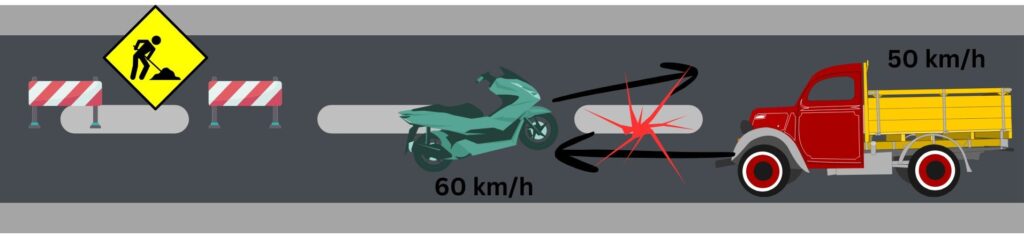
“This is really happening,” I think. “I guess the journey ends here. I won’t see Lombok or Komodo Island.” The thought almost irritates me. I sit up at once, heart pounding from the surge of adrenaline. When I look down, I don’t see a leg, but an alien limb: a shapeless mess of muscle, bone, and tendon that no longer feels like mine.
A geyser of blood starts spurting from what, just seconds earlier, was my knee. The driver, unharmed, is already back on the motorbike, staring at my leg with a look of shock I’ll never forget. I shout at him to help me: “Ambulanz sekarang, permisi” (Ambulance now, please). But he doesn’t move. His eyes are empty. Before I can say anything else, I watch him speed away without looking back.
Abandoned like a stray dog, it dawns on me that everything might end here, on an anonymous curb in Indonesia, thousands of miles from home. I’m shaking uncontrollably, fighting off the urge to pass out. I gather every ounce of strength left in me to wave desperately at passing cars until a small crowd of five or six people gathers around. They look at me as if I’m already done for. One of them even films from a distance, too afraid to come any closer.
A few minutes pass before a man in his sixties finally decides to call for help. He’s wearing a windbreaker; I ask him to hand it over and wrap it tight around my thigh, trying to slow the bleeding. That stranger could have been my father: he squeezes my hand and tries to reassure me, eyes brimming. “Don’t worry, they’re coming.” Still, the wait for the ambulance feels endless.
At 4:28 p.m., I send my live location to my Brazilian friend Julia, who’s up north with her boyfriend, two and a half hours away on winding roads: “Ambulance, please. Amiga, não quero morrer.” Ten minutes later, the medics arrive.
The ride is brutal. With every curve and bump, I can feel the bones grinding in and out of place. I bite down on a blanket from the pain while a nurse presses hard on my thigh, helped by the older man. Julia keeps me company from afar. She’s already jumped on a motorbike to reach me. And it’s her mother—my true guardian angel in those first hours— who’s on the line from Rio de Janeiro with my insurance company to set everything in motion.
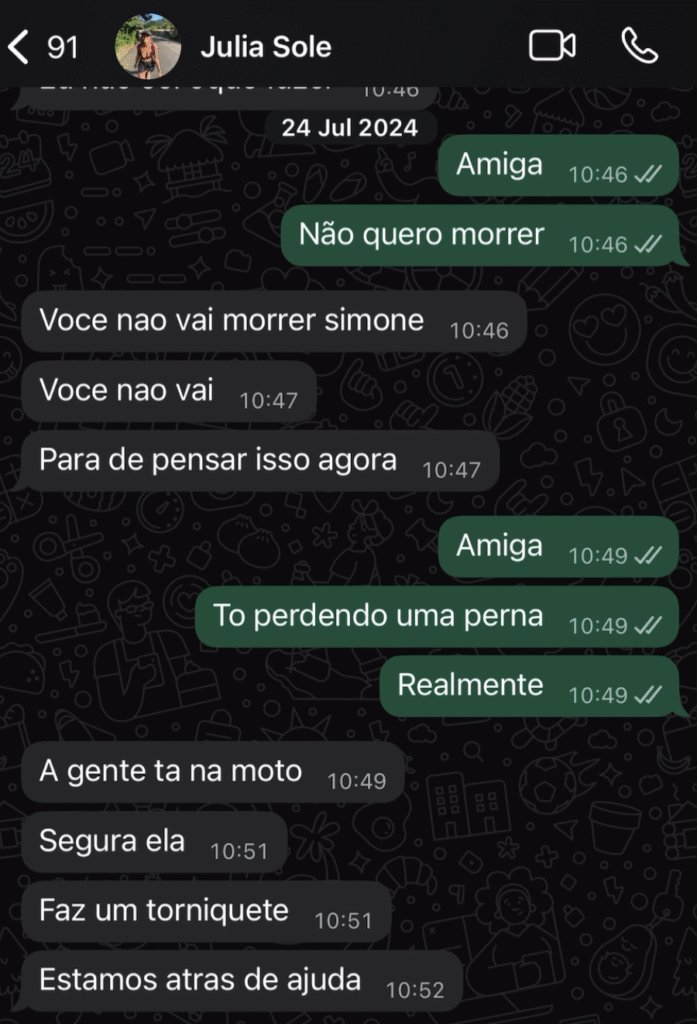
At 4:42 p.m. I arrive at what looks like a small country clinic. They park me in the waiting room, waiting for a triage that never comes. I ask the ambulance nurse to stay by my side and keep pressing on my thigh. It only takes a few minutes for me to realise not only that I won’t be operated on there, but that the staff have no intention of taking me to a proper hospital. I scream, I cry, I thrash for over half an hour: “Send a helicopter, please — I need surgery now.” I try to explain that money isn’t an issue, that I have health insurance, but the on-duty doctor says there’s nothing she can do. There are no hospitals nearby, and no helicopters.
It’s 5:15 p.m. when two police officers walk into the clinic, alerted by witnesses at the scene. I cling to one of them, squeezing his leg: “Please, please, I could be your son, please don’t let me die here.” Something stirs in him — he starts to cry and promises to help. Fifteen minutes later I’m in a new ambulance, headed for a public hospital. I kill time by video-calling one of the most important people in my life: I force myself to laugh and stay alert. This time, it’s the police who hold my leg for me during the ride.
I arrive at RSD Mangusada at 5:39 p.m., just outside Denpasar. The ambulance crew waits until the police leave before handing me over to the ER triage. Weeks later I’ll understand why. The drivers had been told by the on-duty medical staff to lie about my last movements: in the case notes they’ll claim they picked me up at the crash site at 5:30 p.m., omitting the 45 minutes spent at the clinic. When my future lawyers turn up at the emergency room threatening legal action, the doctors will produce a fake discharge letter, filled in and signed on the spot.
The ER waiting room looks like a battlefield. There are many wounded people—among them is an Italian man in his thirties shouting, “Bring me my wife.” The nurses are so busy they ignore my pleas for help. One of them comes close only to say, in a stern voice and with a mocking grin, “You tourists never learn. Motorbikes are dangerous. You will die now.” I try to answer but don’t have the strength. The pain is getting much worse.The adrenaline peak has passed. Nearly two hours have gone by since the crash and I haven’t even had a paracetamol.
A few minutes later the same nurse returns saying they’ll need to turn my leg to compress the severed artery. “Please give me some morphine, at least.” He tells me they don’t have any, but a few minutes later he comes back with fentanyl. Ironically, after having written and spoken about fentanyl many times in 2024, I’m the one to try it firsthand. Not even three seconds after the infusion and they already want to rotate my limb. I ask for at least a bit of wood to bite on during the maneuver. The pain I feel is the sharpest I’ve ever known. Just remembering it still makes my blood run cold. I scream, I cry, and I bite the tongue depressor until it breaks.
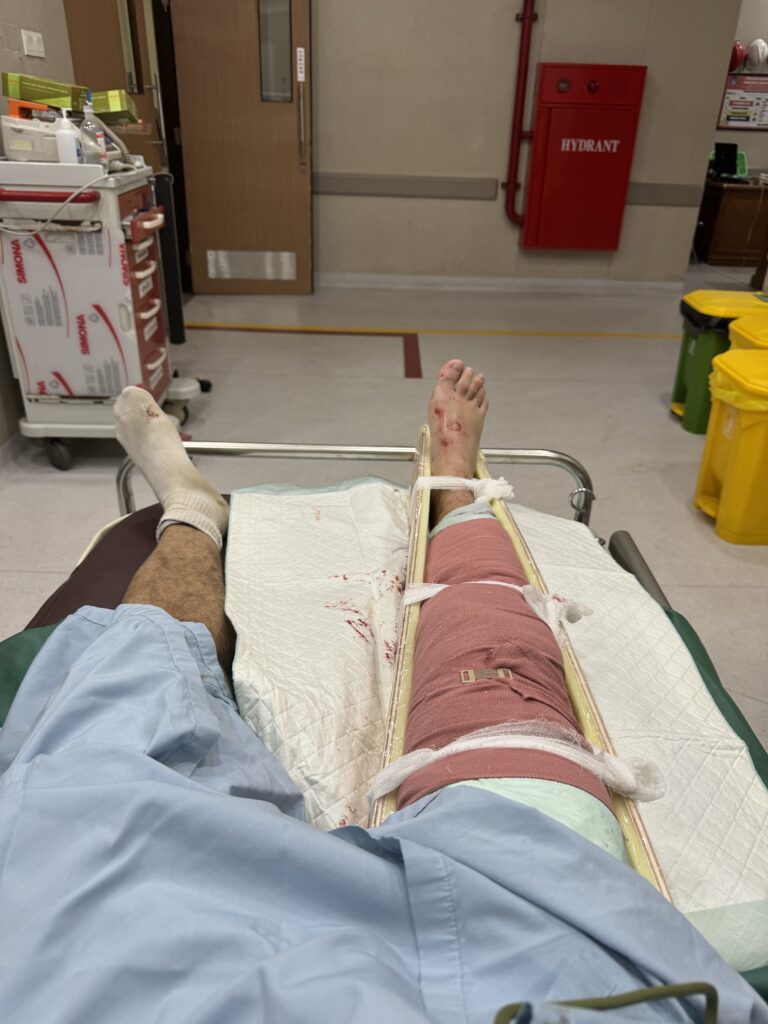
At 6:40 p.m. they wheel me off for X-rays, but no one tells me anything about when surgery might happen. Meanwhile, my leg keeps bleeding. They have to swap out the sheet beneath me every twenty minutes. Just before 7, I hear a familiar voice approaching. It’s my friend Julia. The moment she sees me, she runs over and hugs me, crying. Holding her hands and her boyfriend’s gives me strength. I’m no longer alone. They arrive at the very moment I need them most. My throat is dry, my vision blurred, and my consciousness begins to fade. I ask Julia to call the nurses.
When they check my blood pressure, they look frightened: one signals to the other not to translate. “Lima puluh, tiga puluh,” I hear her whisper—50 over 30. My heart rate has shot up to 150 bpm. They immediately put in two IV lines, pumping 500 cc of saline and Ringer’s lactate into each, but the fluids aren’t enough. Julia buys me two bottles of cold juice, which I gulp down in under ten minutes. Meanwhile, they place a Venturi mask over my face for oxygen, standard protocol in resuscitation maneuvers for class IV hemorrhagic shock.
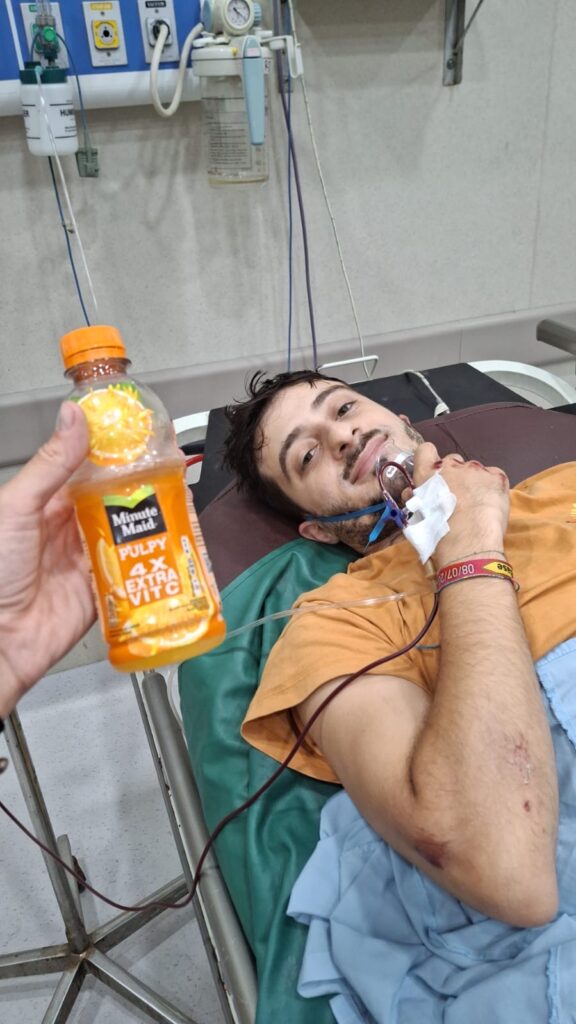
A short time later a bag of blood arrives, the first of six. I begin to pull through. Julia swears I’m even getting a bit of color back. Meanwhile I try to wiggle my toes. Nothing. They don’t budge an inch. The leg feels like a block of marble. I’m terrified I’m heading toward compartment syndrome, with nerves being compressed. Julia forces a reassuring smile, but every time she can she slips away to cry behind a pillar. She asks to speak to the doctors at least three times to find out when I’ll be operated on, but no one can tell her anything.
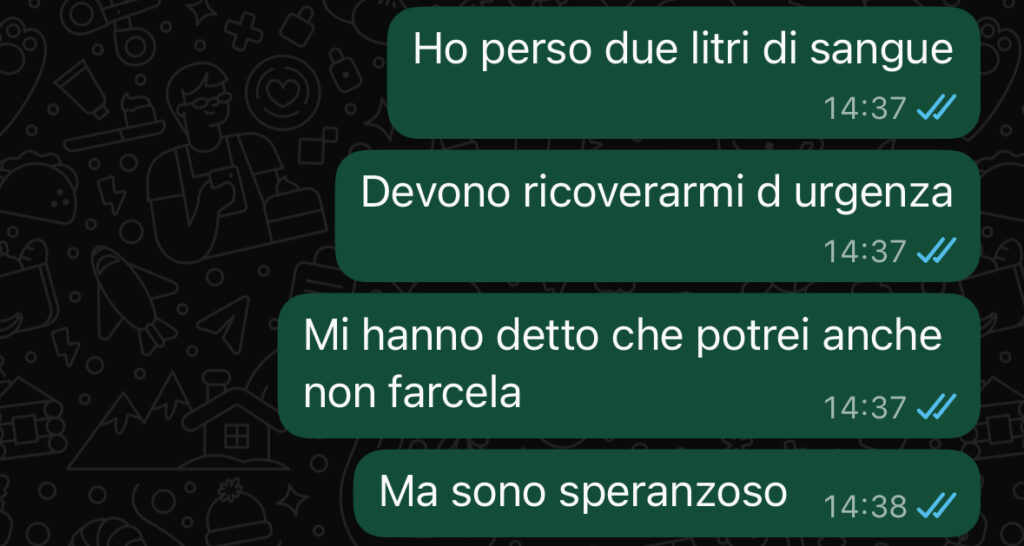
In the meantime I start firing off messages on the various WhatsApp groups of friends: “I’ve lost two liters of blood, they need to operate urgently,” “I swear I’m fighting. I’m trying not to pass out,” “They told me there’s a chance I won’t make it, but I’m hopeful,” “Okay, guys. I love you. Please stay calm.”
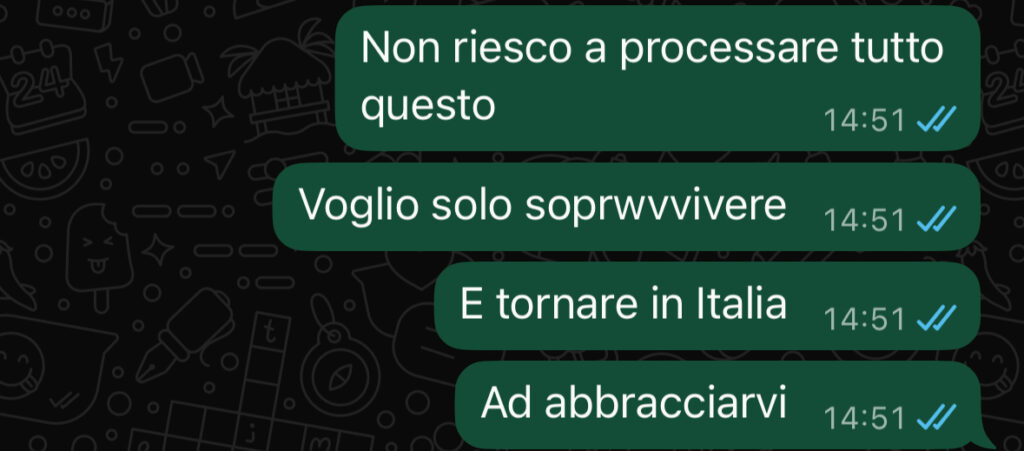
The first video calls start coming in. Seeing my friends’ helpless faces on the other side of the screen kills me. They send messages of strength. “It’ll be okay, one day this will just be a story to laugh about.” They try to hide their shock at seeing me pale as a sheet with an oxygen mask on. Four hours have passed since the crash and I still haven’t found the strength to call my parents.
Then, suddenly—as if she’s beginning to sense something—my mother calls. Not wanting to worry her, I pick up: she asks why she can’t log in to Facebook. I don’t have the strength to explain, and I don’t want her to hear the noises of the ER. I cut the call short after a few seconds. “You’re acting strange. Are you sure everything’s OK?” she asks, then hangs up.
Julia convinces me to face reality. I can’t hide something this big. I need my family. I call her back with a choked voice: “Mom, actually, it’s not OK.” One by one they all ring me. My sister’s first reaction is a scream of despair: “Why? Why me? What the f** did I do wrong in my life to deserve this?”* My other siblings try to stay calm.
Shortly after 10 p.m. local time we get the news there are no surgeons available. They say they’ll transport me to another hospital for the operation, but there’s no timetable. “Not before five in the morning,” an orderly says. The thought of waiting another six hours feels like it’s killing me.
Meanwhile, Julia coordinates all the bureaucratic procedures with the insurance company, helped by her mother in Rio de Janeiro. For ten straight hours they make calls and send emails. The hospital demands proof of payment for every single bag of blood and vial of fentanyl I receive.
Six hours after the crash they give me the first dose of antibiotics to ward off sepsis. Despite the bags of fluids and blood, not a single drop of urine comes from the catheter. I’m in renal failure. The hours from midnight to three are the hardest. The ER empties out and I’m left on a gurney with Julia holding my hand. The phone won’t stop ringing. At two a.m. I have one last video call with my mother, the most wrenching of all. I’ve just signed the consent form for the transfer and the operation, accepting about a 50% risk of death. “I’m calm. Whatever happens, I love you. Thank you for these twenty-nine years together.”
Those aren’t set phrases. I begin to feel a real serenity inside me. I tell myself maybe my fate is already written. I’ll do everything I can to survive. I owe it to my family and my friends. But not everything can be under my control.
With Julia holding my thigh steady, the transfer turns out to be less painful and traumatic than I feared. But when we arrive at Murni Teguh Hospital in Denpasar (around 3:30 a.m.), a new snag appears. Reception insists on an upfront payment from the insurance. The authorization takes an hour and a half to come through.
By then I’m wrecked: the combined effects of fentanyl and benzodiazepines have me on the verge of sleep. The doctors tell Julia to keep me awake, so she puts Charli XCX’s “Von Dutch” on repeat, my new Brat Summer 2024 obsession. I wave my arms and laugh, thinking how absurd and beautiful life can be. Julia sends the video of me dancing to everyone in the WhatsApp group set up for updates, “Simone News.”
This is my last farewell before the operation. Just before five in the morning they call me into the operating room. I tremble from the cold and the fear. Before the anaesthetic takes hold, I run through the faces that matter most. My nephew Leo, my closest friends. My mind drifts to Sicily and Nocera Inferiore as consciousness begins to slip away. “Goodbye,” I think. “See you soon,” I hope. I’m ready.