
The crash, the rescue and the surgery

I’m smiling as I take the long staircase two steps at a time, climbing back up from the Nungnung Waterfalls in the middle of the island. My Grab driver (Indonesia’s version of Uber) is waiting for me at 4 p.m. sharp at the top of the trail. I’m still wet and cold from the swim when I get back on the scooter, heading to Ubud.
The plan is to get back to the hostel as soon as possible, grab my backpack, and head to Denpasar shortly after sunset.
I don’t know yet that I’ll get to Denpasar even sooner than expected.
Just not on my own legs.
At 4:22 p.m., my driver overtakes a construction site on the right (in Indonesia you drive on the left), in a rural area. That’s when I see a red truck appear at the end of the straight road. He must have seen it too, but he doesn’t move from the middle of the lane. I want to shout, “What are you waiting for?”
The longest five seconds of my life go by. Then I realize the impact is unavoidable. My blood runs cold. The sound of the horn hits me, getting higher and higher. Then the rush of air. The scooter swerves sharply to the left, but it’s too late.
A huge red shape flashes just inches from my face.
I feel something tear through my right leg.
Then I’m airborne.
Thrown forward, I slide and roll for more than five meters on the asphalt before slamming into the curb.
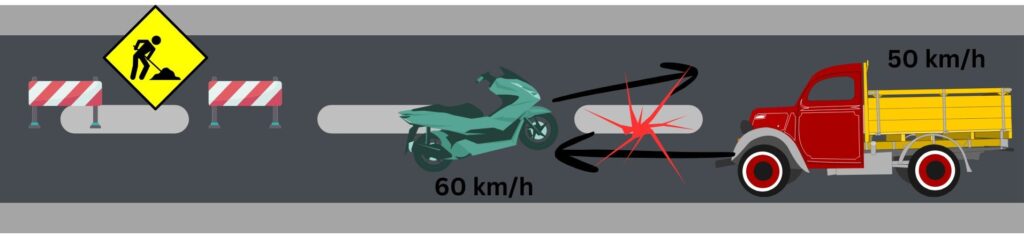
“This is really happening,” I think.
“I guess the trip ends here. I won’t see Lombok or Komodo Island.” I’m almost annoyed. I sit up immediately, in an adrenaline rush. When I look down, I don’t see a leg, just something alien that doesn’t belong to me.
The blood starts pouring out from what, just seconds before, was my shin. I press on the exposed bone, trying to push it back in. Meanwhile, the driver is already back on his bike, completely unharmed. He yells something at the truck driver. Then he stares at my leg with a look of shock I’ll never forget. I shout at him to help me: “Ambulance sekarang, permisi” (ambulance now, please). But he doesn’t react. His eyes are empty. Before I can say anything else, I see him leave, without even turning back.
I realize this is how it ends. On some anonymous sidewalk in Indonesia, thousands of miles from home.
I force myself not to pass out. From my perspective I can no longer see the truck. I gather what little strength I have left to scream and wave at the passing cars. Some stop, but only to pull out their phones and film. They look at me like I’m already gone. They shake their heads, as if to say, “Poor tourist, another road victim.” Then they drive off.
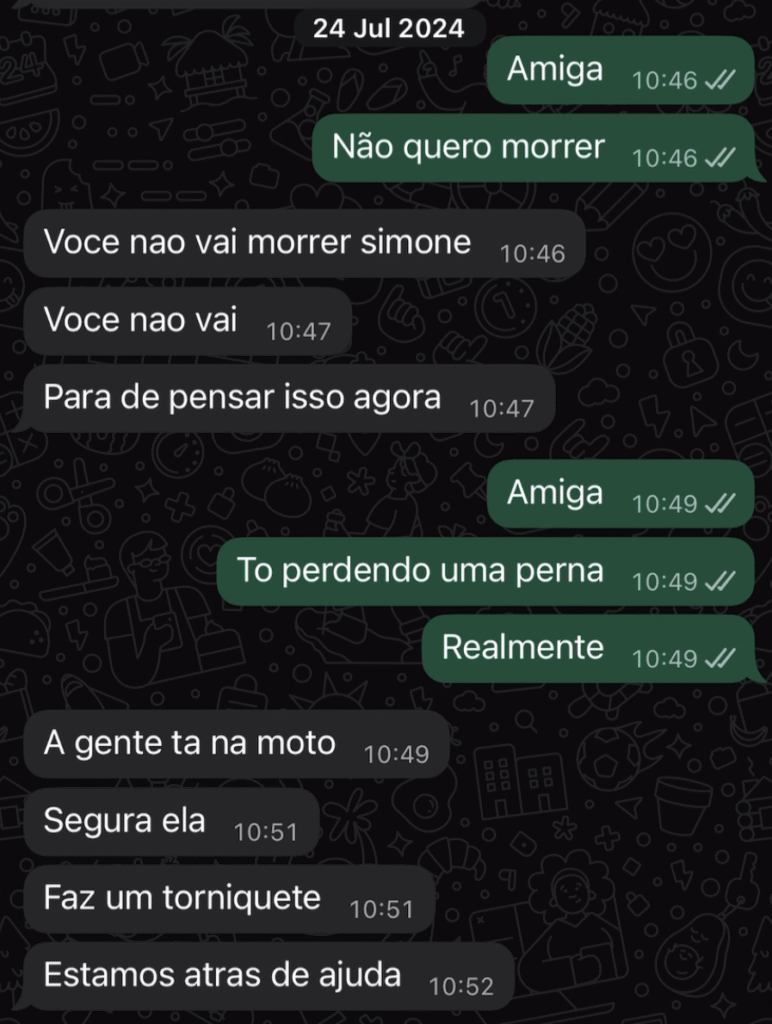
At 4:28 p.m., I send my live location to my Brazilian friend Julia. She’s in the north of the island with her boyfriend, two and a half hours away:
“Ambulance, please. Amiga, não quero morrer.”
Five or ten minutes pass before a man in his sixties offers to call for help. He’s wearing a windbreaker. I ask him for it and tie it tightly around my thigh as a makeshift tourniquet to slow the bleeding. That stranger could be my father: he holds my hands and tries to calm me down. “Don’t worry, they’re coming.” I lie there on the ground, staring at the palm trees and the sky, trying to stay conscious. I use my camera bag as a pillow.
Ten minutes later, the ambulance arrives. The ride is brutal: every bump in the road makes the bones shift in and out of my leg. I bite down on a blanket from the pain, while a nurse presses hard on my thigh, helped by the man. Meanwhile, Julia is flooding me with messages — she’s already on a motorbike, on her way to reach me. Her mother — whom I’ll never stop thanking — is on the phone from Rio de Janeiro with my health insurance, trying to get assistance activated.
The ambulance ride is much shorter than expected, and I don’t like that. At 4:42 p.m., I arrive at a small rural clinic. They leave me in the waiting room, waiting for a triage that never comes. I ask the ambulance nurse to stay by my side and keep pressure on my leg.
It only takes a few minutes to understand that I won’t receive any treatment, and that the doctors have no intention of transferring me to a real hospital. I scream and cry for half an hour. I feel completely helpless. “Send a helicopter, please. I need surgery now.” I try to explain that money isn’t an issue, that I have health insurance, but the doctor on duty says there’s nothing she can do.
There are no hospitals nearby. And certainly no helicopters.
At 5:15 p.m., two police officers walk into the clinic, probably alerted by the same man who helped me. I grab one of them by the leg: “Please, please… I could be your son. Please, don’t let me die here.” Something shifts in him. He looks at me with tears in his eyes and promises to help.
Fifteen minutes later, I’m in another ambulance, heading to a public hospital. This time, it’s the police officers holding my leg. I start to feel a bit of hope again. I take the chance to video call one of the most important people in my life. Talking helps. Reconnecting with Europe makes me feel grounded.
I’m not just another anonymous victim of the Indonesian roads. There are people back home waiting for me.
A reason to fight.
At 5:39 p.m., I arrive at RSD Mangusada, just outside Denpasar. The ambulance crew waits until the police officers have left before handing me over to the emergency room triage. Weeks later, I’ll find out why. The drivers had been instructed by the clinic staff to lie about my movements: in the medical history they claim they picked me up at the accident site at 5:30 p.m., leaving out the 45 minutes I spent at the clinic. When my future lawyers later show up to ask for explanations, the doctors produce a fake discharge letter, filled out and signed on the spot.
The ER waiting room looks like a battlefield: there are many injured people. Among them, another Italian man in his thirties: “Bring me my wife,” he shouts. The nurses are so busy they ignore my calls for help. One of them comes over with a mocking grin.
“You tourists never learn. Motorbikes are dangerous. You risk to die now.”
I try to answer, but I don’t have the strength. The pain is getting much worse now. The adrenaline has worn off. It’s been almost two hours since the accident, and I haven’t even had a paracetamol.
After a few minutes, the same nurse comes back and tells me he has to twist my leg to compress the ruptured artery. “Please, give me some morphine, at least.” He says they don’t have any, but a few minutes later he returns with fentanyl. Life is absurd: after writing and talking about fentanyl so much in 2024, now I’m the one experiencing it firsthand. Not even three seconds after the injection, they already want to move my leg. I ask for at least a piece of wood to bite down on during the procedure.
The pain is the most intense I’ve ever felt. I scream, cry, and bite down on the tongue depressor until it snaps.
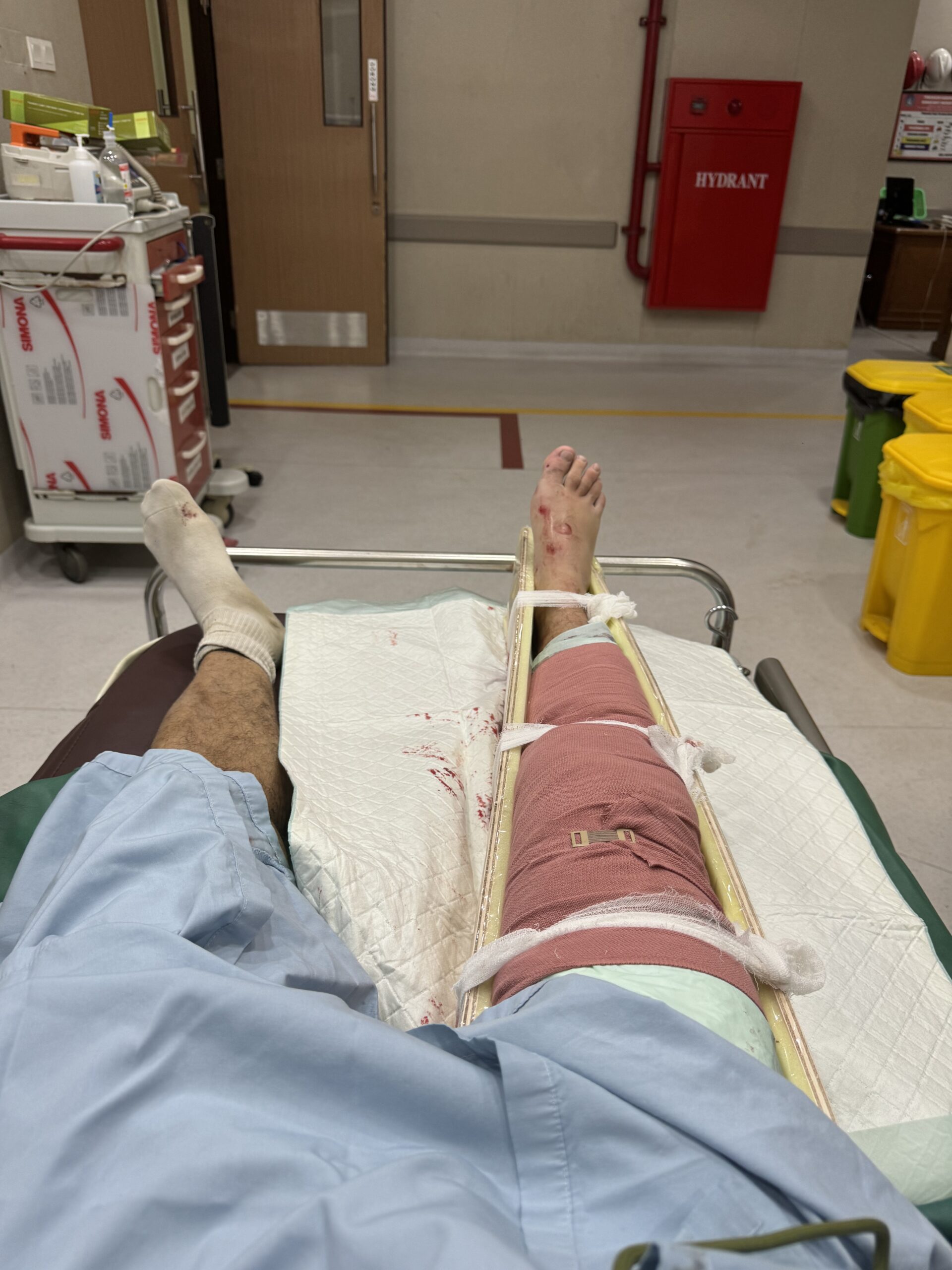
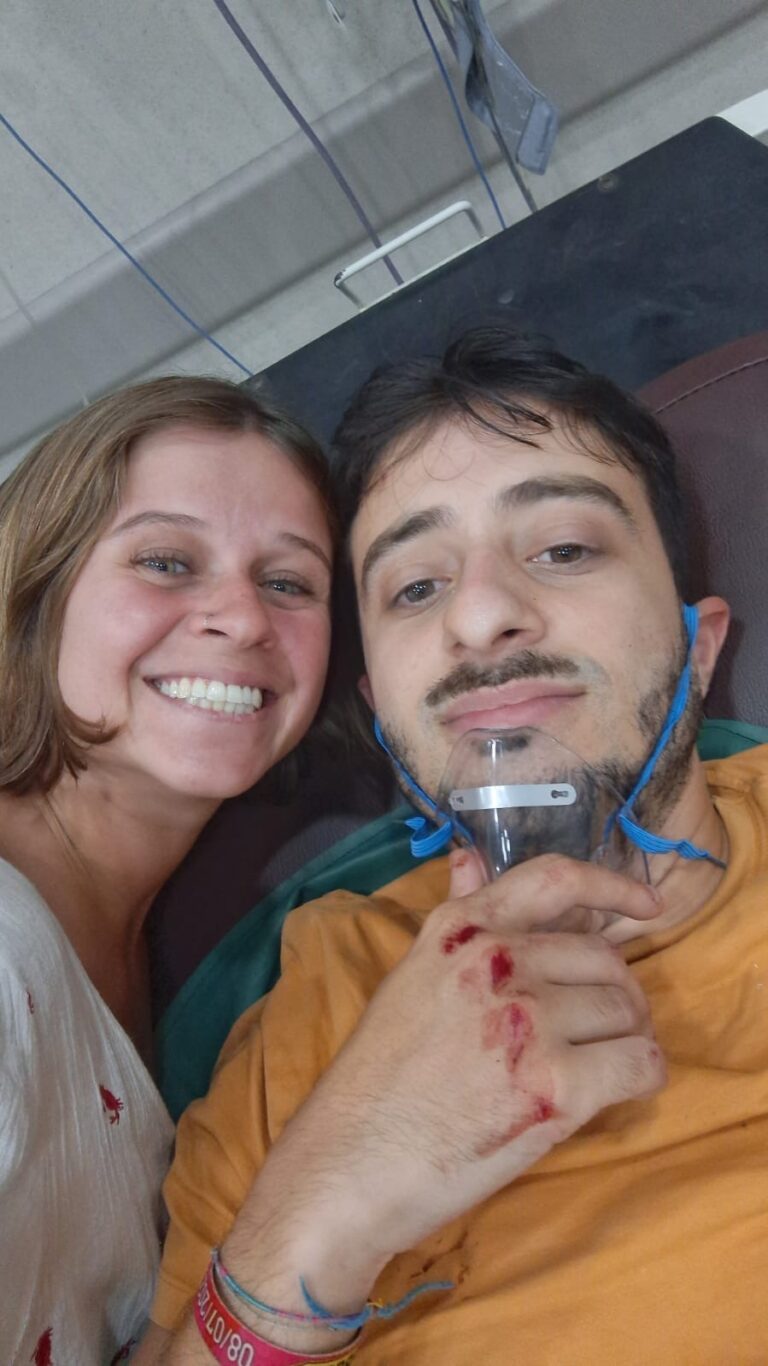
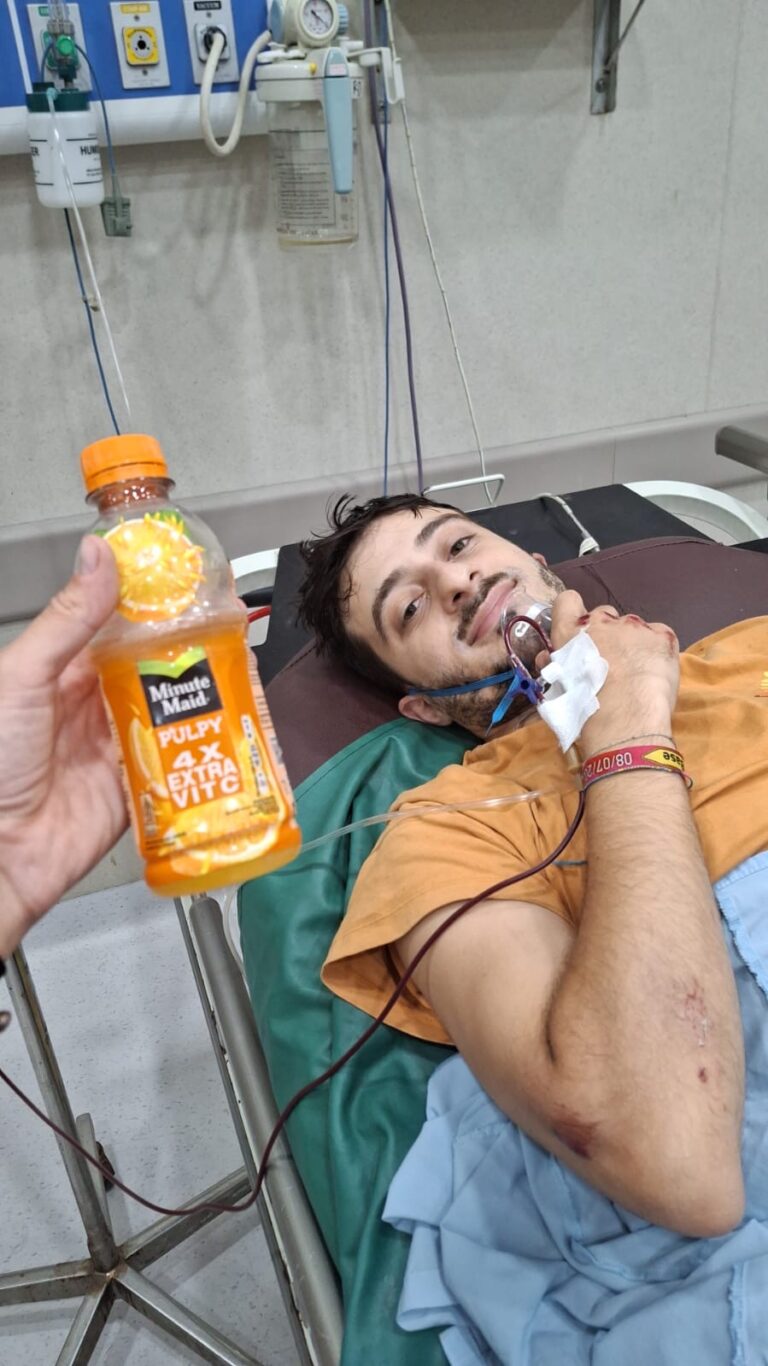
At 6:40 p.m., they take me for X-rays.
Open, comminuted fractures of the patella, femur, tibial plateau and tibial shaft are diagnosed.
Later on, I would discover that I had also sustained five fractures in the foot, an arterial injury, rupture of the quadriceps and patellar tendons, as well as injuries to all the ligaments of the knee.
No updates on the timing of the surgery yet. Meanwhile, my leg keeps bleeding. They have to change the pad every twenty minutes.
Just before 7 p.m., I hear a familiar voice. It’s my friend Julia. She runs to hug me, unable to hold back her tears. Holding her hands — and her boyfriend’s — gives me strength.
I’m not alone anymore.
They arrive at the exact moment I need them most. My throat is dry, my vision is blurred, and I’m starting to lose consciousness. I ask Julia to call the nurses.
When they check my blood pressure, they look alarmed: one of them signals to the other not to translate. “Lima puluh, tiga puluh” (50 over 30), I hear them whisper.
My heart is racing. I’m in class III-IV hemorrhagic shock.
They immediately put in two IV lines, but fluids aren’t enough.
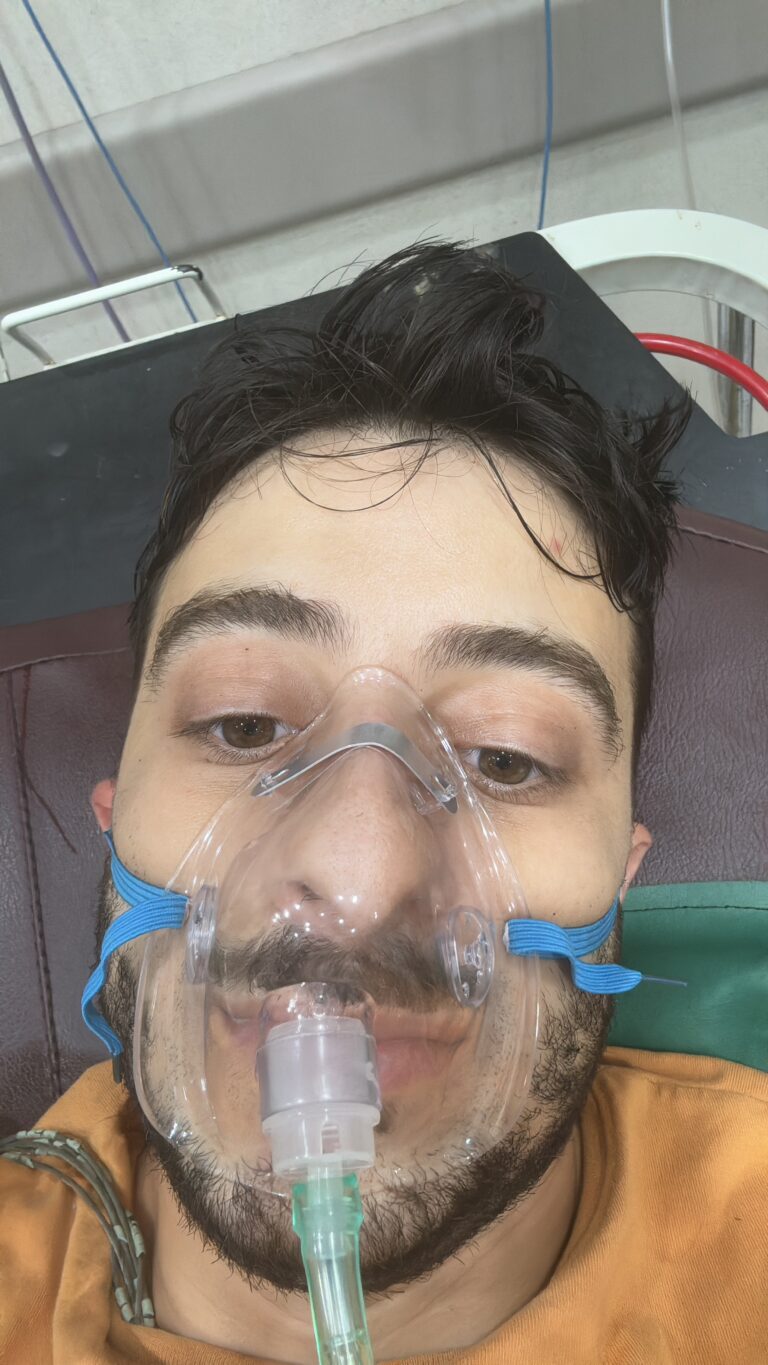
Julia buys me two small bottles of cold juice, which I drink in less than five minutes. Meanwhile, they put a Venturi mask on me for oxygen, as per resuscitation protocol. BP is now 70/40.
Shortly after, the first bag of blood arrives. I start to recover. Julia says I’m even getting some color back. Meanwhile, I try to move my toes, but nothing. They don’t move at all. My leg feels like a block of marble. I’m terrified I might be developing compartment syndrome, with pressure on the nerves. Julia tries to smile at me reassuringly, but whenever she can, she goes off to cry behind a column. She asks to speak to the doctors at least three times to find out when I’ll be taken into surgery, but no one can give her an answer.
In the meantime, I start writing in my WhatsApp groups.
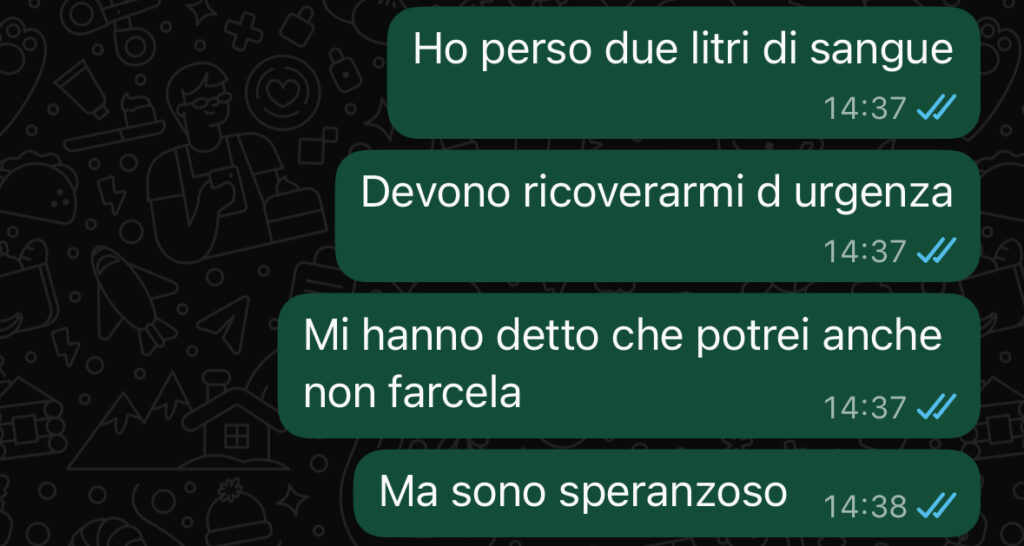
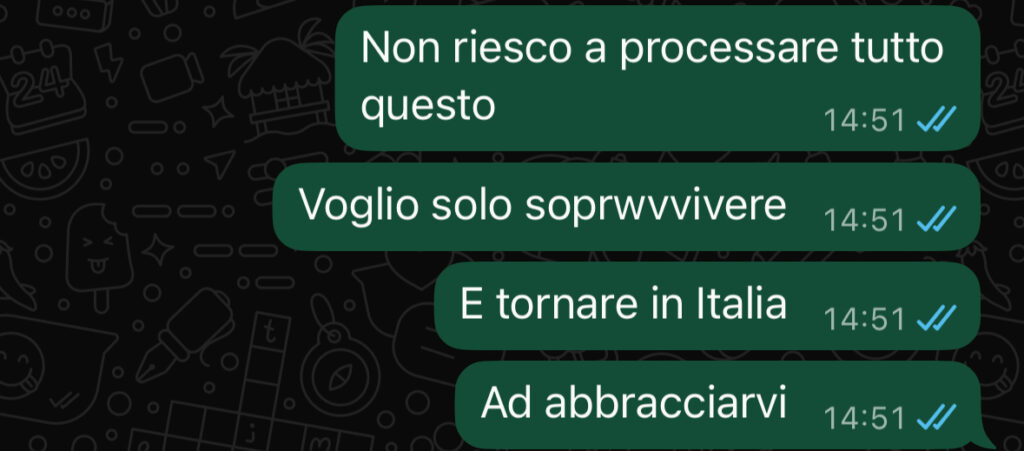
The first video calls start coming in. My friends try to hide the shock of seeing me pale as a sheet, with an oxygen mask on. Seeing their helplessness on the other side of the screen breaks me. They try to give me strength: “Everything’s going to be fine. In a few weeks we want you back here dancing to techno.”
It’s been four hours since the accident, but I still haven’t found the strength to call my parents. Then, suddenly — as if she’s starting to sense something — my mother calls. I answer so I don’t worry her. She asks why she can’t log into Facebook. I don’t have the energy to explain, and I don’t want her to hear the noise of the ER. I cut the call short after a few seconds.
“You sound strange. Are you sure everything’s okay?” she asks before hanging up.
Julia convinces me to face reality. I can’t hide something this big. I need my family. I call her back, my voice breaking.
“Mom… actually, everything is not okay.”
One by one, they all call me. My sister’s first reaction is a scream of despair:
“Why? Why does this always happen to me? What the hell did I do to deserve all this?”
My other siblings try to stay calm. Just after 10 p.m. local time, the news comes: there are no surgeons available. They would transfer me to another hospital for surgery, but no one knows when.
“Not before five in the morning,” a nurse says.
Meanwhile, Julia and her mother coordinate the paperwork with the insurance company. The hospital demands proof of upfront payment for every single unit of blood and every vial of fentanyl I receive. The Coverwise assistance center is about to transfer me to one of their partner facilities to streamline the process, but that could mean even longer delays for surgery.
Six hours after the accident, they finally give me my first dose of antibiotics to prevent sepsis. Despite all the fluids and blood I’ve been given, not a single drop of urine has come out of the catheter. My kidneys are shutting down. The hours between midnight and three are the hardest. The ER empties out, and I’m left on a stretcher with Julia holding my hand. My phone doesn’t stop ringing.
At 2 a.m., I have my last video call with my mother — the most painful one. I’ve just signed the consent form for the transfer and the surgery, accepting a 30–40% risk of death.
“I’m at peace. Whatever happens, I love you. Thank you for these twenty-nine years together.”
These aren’t empty words.
A strange sense of calm really starts to settle inside me.
I tell myself that fate is bigger than all of us. I’ll do everything I can to survive. I owe it to my family and my friends. But not everything is under my control.
With Julia holding my thigh steady, the transfer is less traumatic than expected.
When we arrive at Murni Teguh Hospital in Denpasar (around 3:30 a.m.), there’s another complication. At reception, they demand upfront payment for the entire surgery from the insurance company. It takes an hour and a half for the authorization to come through. Meanwhile, I’m exhausted. From the combined effect of fentanyl and benzodiazepines, I’m drifting off to sleep. The doctors tell Julia to keep me awake. She puts on Brat by Charli XCX on Spotify. Von Dutch, in particular, has become my new obsession in this Brat Summer 2024. I wave my arms and laugh, thinking how lucky I am, despite everything. Julia records a video of me and sends it to my friends in a WhatsApp group created just for updates, “Simone News.”
It’s my last goodbye before the surgery. Just before 5 a.m., they call me into the operating room. I’m shaking from the cold and the fear. In the moments before the anesthesia, I run through the faces of the most important people in my life: my nephew Leo, my closest friends. My mind drifts to Messina, Rome, and Nocera Inferiore.
“Goodbye,” I think.
“See you again,” I hope.