
Back to Italy
When I leave the hospital in Denpasar, I see life in color again.
Being surrounded by so many people at the airport makes me feel alive: my eyes run over every face, the clothes people wear, the food in the cafés. For the first time in weeks I find myself joking and chatting in a familiar language with the Catalan doctor and nurse. They are incredibly kind to me. They even give me a notebook and a pen so I can start writing my story.
At the security checks everything goes smoothly. The problem comes when it’s time to board the plane: at the entrance I’m forced to change wheelchairs and, to do that, I have to stand up and turn around, even if only for a few seconds. After weeks in bed my blood pressure is extremely low, and it takes very little for me to lose my balance.
The flight with Emirates is amazing and given the price, it couldn’t be otherwise. The insurance paid €25,000 for the transfer.
I eat as if I hadn’t eaten in weeks. The seat-bed is incredibly comfortable: I spend hours watching series on the tablet. I feel so calm that I even manage to fall asleep without benzodiazepines.
We have a layover in Dubai, where the doctor and nurse themselves end up asking for assistance because they feel sick from food poisoning. A doctor assisting a doctor assisting another doctor. We laugh, thinking of the three Spider-Man meme. After another flight we arrive in Fiumicino Airport in Rome. We say goodbye: even if only for a short time, it was a pleasure sharing the journey with two people my age.
A bit like getting back on the road with other backpackers.
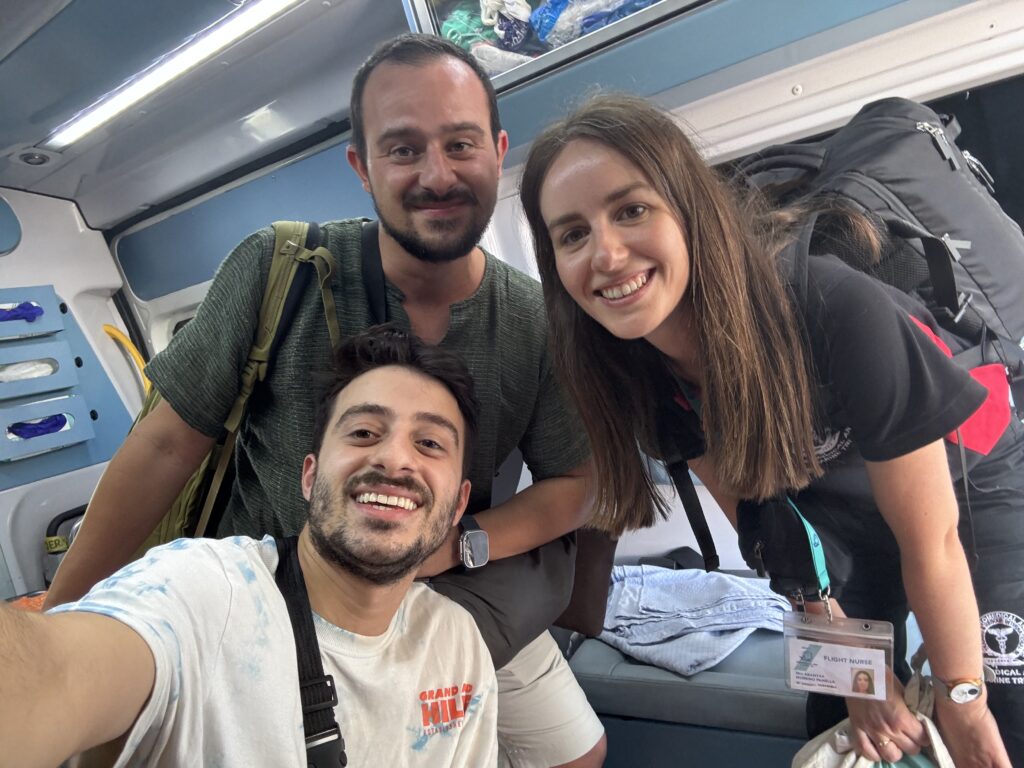

Outside the airport, an ambulance is waiting for me. Destination: the Rizzoli Institute in Bologna.
I was the one who asked to be transferred to one of Italy’s leading orthopedic centers. Years earlier, when I was studying medicine, I had done an internship there. (I wouldn’t have had this opportunity without the invaluable help of Gianni Riotta, the director of my journalism master’s program, who contacted the hospital’s leadership to coordinate the transfer.)
Lying alone on the stretcher, with the sound of the sirens, brings back the trauma of the accident. After four very long hours, we finally arrive in Bologna.
I feel at home. The doctors and nurses speak my language, they take care of me, they make me feel safe.
In the following days I undergo X-rays, CT scans, and Doppler ultrasounds.
The surgeons tell me I’m lucky to be alive, incredibly lucky to still have my leg.
“You’ve got luck the size of the Asinelli Tower.”
They assure me, however, that my leg will never be the same again.
I have a near 100% risk of developing osteoarthritis and needing a knee replacement within the next 10 years.
No more running, jumping, or high-impact sports. For someone like me, who is hyperactive, it feels like a loss that is hard to process. A constant thought that will keep me up at night in the months to come.
I still have to undergo two more surgeries: one on the femur and one on the foot, where I have two displaced fractures in the metatarsals. They manage to schedule both procedures on the same day, August 19, so that I can avoid going through anesthesia twice.
While waiting for surgery, I receive my first visitors. I hug friends whom I thought I might never see again. They bring me clothes, wet wipes, and comfort food — even a lucky talisman and some incense for a purification ritual. I eat, laugh, joke, and play cards. They wheel me around the inner courtyards of the Rizzoli in a wheelchair.
It’s a kind of joy I will never quite be able to put into words: having familiar hands to hold again, friendly shoulders to cry on, while I recount the incredible experience I’ve been through.
After many more tests, on the 19th I’m taken into the operating room. The surgery is long, but nothing compared to the one in Indonesia. It almost feels fun. To sedate me they use ketamine and propofol. I start singing “Take Me Home, Country Roads,” while dreaming of gliding over Colombia.
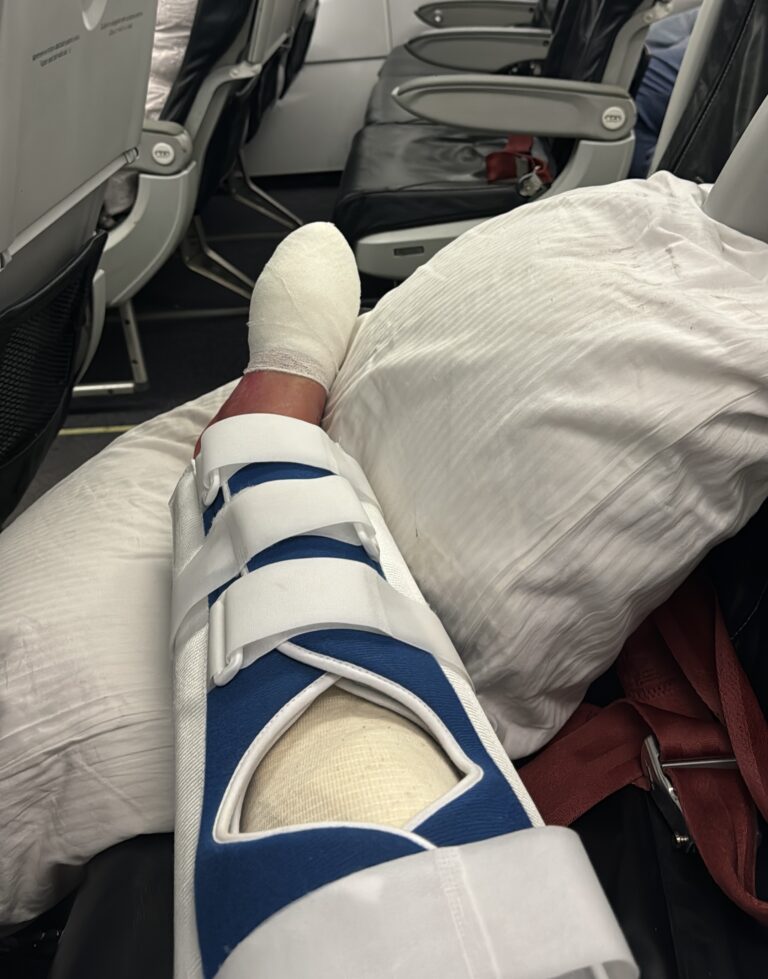
After five days, it’s time to be discharged. Reckless as usual, I decide to travel back to Sicily on my own, without the help of friends or family. I take a taxi to the airport, where disability assistance is already arranged.
There’s one major problem, though: I bought a regular ticket and I can’t bend my leg more than 30 degrees. Looking back, I realize it was a crazy decision. Luckily, the captain of the ITA Airways flight is supportive from the very beginning. He makes sure I get a business-class seat on the first leg and an entire row of seats on the second, so I can keep my leg stretched out.
Outside Catania airport, my brother is waiting for me. I spend the night at his place before returning to my parents’ house. The bedrooms are upstairs, but for the occasion he has prepared a small bed for me at the entrance, with a bedside table next to it: wet wipes, a urinal bottle, and medications for every need. This kind of thoughtfulness is far from obvious.
It’s something I will see often in the months to come from friends and family. Something that will never stop moving me.
Back home
August 24, 2025. One month after the accident, I step back into my home. My whole family is there waiting for me, including my three-year-old nephew.
Hugging them all again is beyond words. But I can see a great deal of pain in their eyes: they didn’t expect to see me so worn down and battered, drowsy from benzodiazepines and opioids.
From the very first day, my parents do everything they can to meet my needs. They move furniture around, making the house a little more accessible.
We create a procedure for everything: eating, washing, going to the bathroom.
Next to the bed there’s a three-tier bedside table with everything I might need during the day or the night. At mealtimes I reach the kitchen using a walker or the wheelchair. Then I eat lying down on the couch.
In both bathrooms there’s a step: at first I need some help. With time I learn to climb over it by pushing with my arms. I can’t get into the bathtub, so I have to wash myself bit by bit, using the bidet and a bowl of water.
At first this routine is almost reassuring. I’m looked after, I have fast Wi-Fi and a laptop to read or watch series.
But my mind is fragile. It’s already late August, summer is ending, and I realize I’m missing out on pieces of life. My friends are posting Instagram stories from all over the world. My fellow journalism students are about to begin their first newsroom internships.
Meanwhile I am stuck in bed, for who knows how long, with the certainty that my leg will never be the same again.
In September the most difficult period of my life begins. The routine becomes a cage.
Every day is the same. I persuade my father to take me outside in the wheelchair, but the experience is disastrous. As soon as we reach the street, the trauma of speed comes rushing back. I start shouting, begging him to slow down. I can’t even tolerate the 4 km/h of a normal walking pace.
I try again a few days later. This time the wheelchair is pushed by one of my best friends, Cepo, who has come from Vienna for the weekend with his girlfriend. The days spent with them are the absolute highlight of the month, along with the visit of another dear friend, Eleonora. The rest of the time I can’t bring myself to get out of bed, not even for meals. If before I used to eat on the couch, it becomes routine to eat in my room, alone. Breakfast, lunch, and dinner.
My parents grow worried. They realize something is wrong. My mother tries to break the wall of silence I have built around myself, but every time I lash out at her. I insult her, throw objects against the wall. I’m not myself anymore.
After the accident, I had felt as if I had acquired an aura of sanctity, of purity. As if life owed me something.
That aura is gone. I feel contaminated.
The gratitude of having survived gives way to a deep anger. To the frustration of inhabiting a disabled body, forever altered by an accident that only lasted a second.
My relationship with my parents begins to crack. The more it cracks, the more guilty I feel, yet a perverse part of me seems almost pleased to see them pull away. I realize that, for the sake of the family, I need to leave.
I convince my father to drive me to Bologna for my monthly check-up. From there, the plan is to return to Rome, where I share an apartment with roommates. My mother is skeptical: she thinks I won’t be able to manage on my own. I have my doubts too, but I have to react.
In Sicily, I am slowly fading away.
Back to Rome
Once again, the turning point comes on the 24th: September 24.
The first forty-eight hours in Rome are a period of adjustment. My father takes me to the local health authority (ASL) to register with a general practitioner and activate home physiotherapy. He helps me do the groceries and turn the apartment into a place adapted to my disability.
After a few days he returns to Sicily, but I’m no longer alone. My roommates are there, ready to help me with anything. In reality, I need much less help than expected. I start developing my own strategies to cook, drain pasta, wash the dishes, and go to the bathroom.
Rediscovering my independence fills me with optimism.
I feel ready to receive my first visitors. In October my house fills with life. Friends and colleagues come over for lunch or dinner, stay to study or work remotely, and sometimes sleep on the couch.
Since I can’t go out, for several weekends the party moves into my living room.
With a JBL speaker and a bottle of amaro, we improvise techno and karaoke nights.
It is a peaceful time.
I get along well with my first two physiotherapists too. The daily knee-mobilization session becomes an integral part of a routine that, all things considered, I don’t mind.
At least at the beginning.
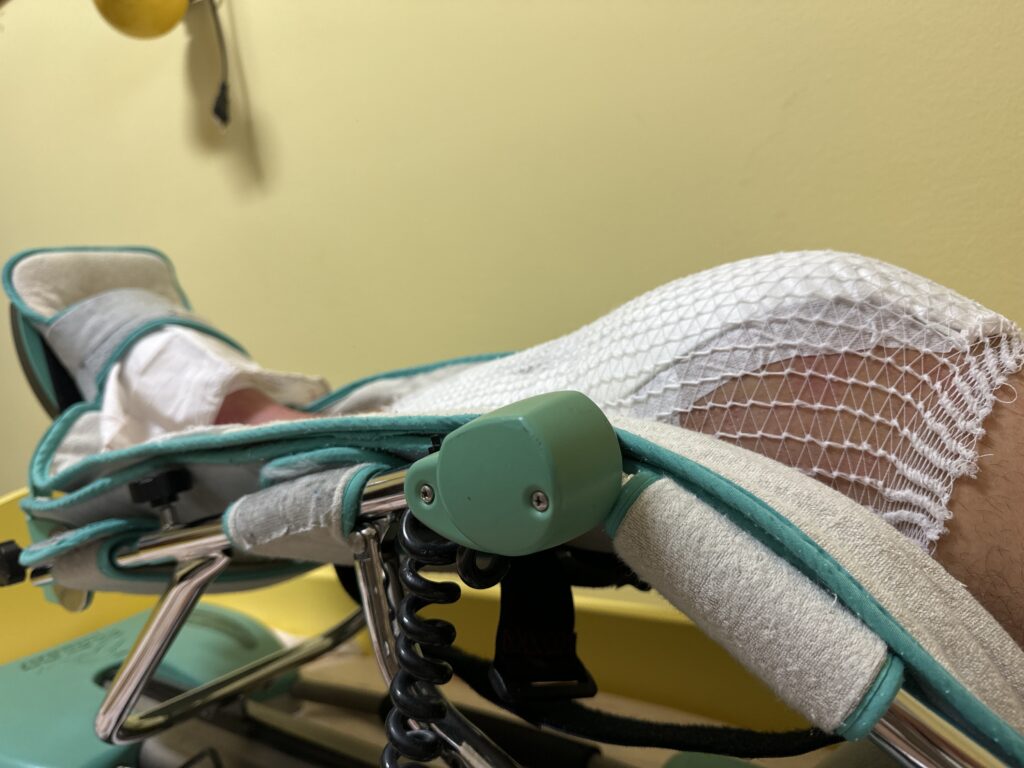
The gentle maneuvers of the first few weeks do not bring the results we hoped for: the knee will not bend more than 35–40 degrees. We have to move to more aggressive techniques and work at a pain level of 9 out of 10. The sessions become so traumatic that I start feeling anticipatory anxiety already the day before. I go back to taking opioids, which I had gradually discontinued in the previous weeks. Tramadol makes me nauseous and causes vomiting, but it still cannot cover the pain. Every time we try to force the block, I end up crying and screaming.
The best days are the ones that begin with a message from the physiotherapist:
“Sorry Simo, I can’t come today. See you tomorrow.”
After a few weeks like this, we realize there is nothing we can do. The surgeons in Bologna confirm it as well: to unlock the knee I will need another operation, an arthrolysis according to Judet. But before that, we have to wait for the tibia to fully consolidate.
In the meantime, my life begins to return to a kind of pseudo-normality.
I start going outside, accompanied by my friends while I’m in a wheelchair. The first place I manage to “unlock” is Villa Ada park. As I begin to gain confidence with crutches, I’m able to move around on my own, all the way to the Virgiliano, to soak up some sun. By mid-October, I find the courage to overcome my own personal Pillars of Hercules: the 64 steps that separate me from the Sant’Agnese Annibaliano metro station. I unlock the whole city of Rome.
A phase of firsts begins: the first dinner at a pizzeria, the first techno DJ-set in a club, the first step with a crutch, the first step without crutches, the first shower after three months.
Facing the outside world after months of isolation is exhilarating, but at the same time it terrifies me. I no longer feel at ease on the streets, on public transport, or in the middle of a crowd—me, who has always loved the chaos of city life. On four occasions, I experience full-blown panic attacks, with difficulty breathing and a sense of impending death. It happens on a bus or a train, far from home, with no familiar face around. Other times, I manage to recognize the early signs and take action, looking for a quiet place to sit down.
The triggers are almost always the same: pitch darkness, the sound of motorbikes or ambulances, heavy traffic, neon lights that remind me of the hospital.
As the weeks go by, and with some psychological support, I learn to manage my fears and make them less disabling. By late autumn, I leave the house on my own, day or night.
I recover so quickly that by December I’m able to attend my master’s classes in person again. I can walk for ten or fifteen minutes without fatigue. I only have a slight limp.
For a few months I truly believe I might return to a normal life. I sign up for a theater course. On January 24 I rent a ranch to celebrate my thirtieth birthday with all the people I love.