The collapse
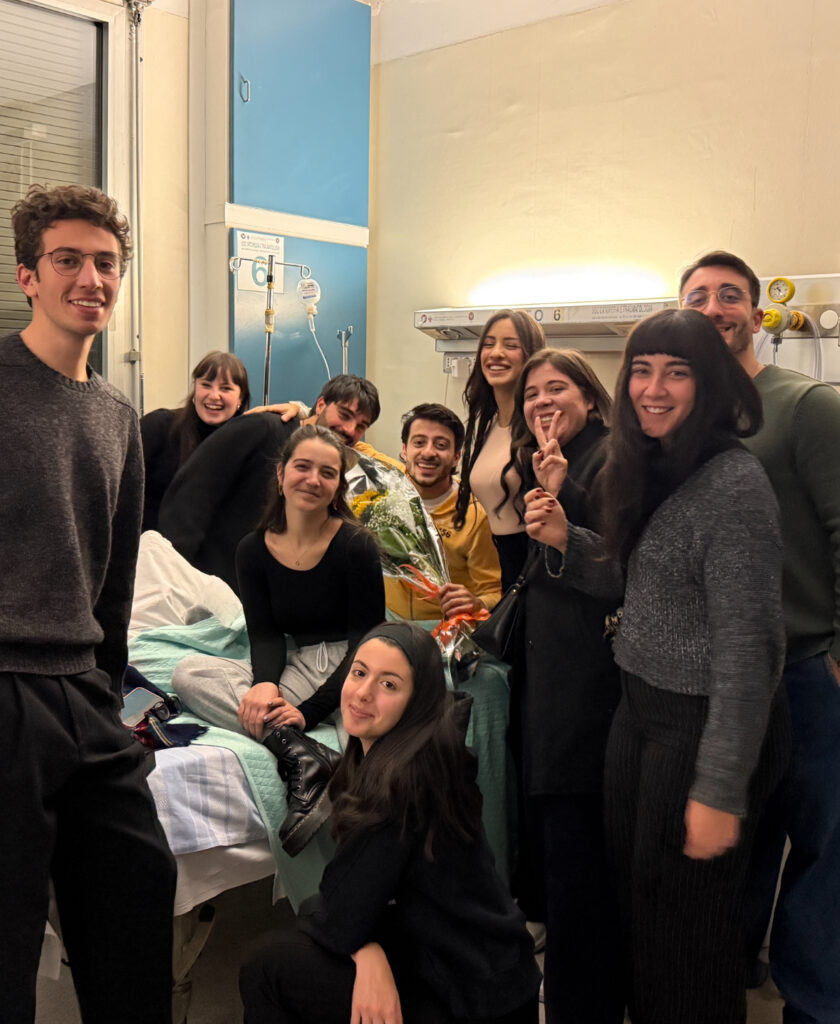
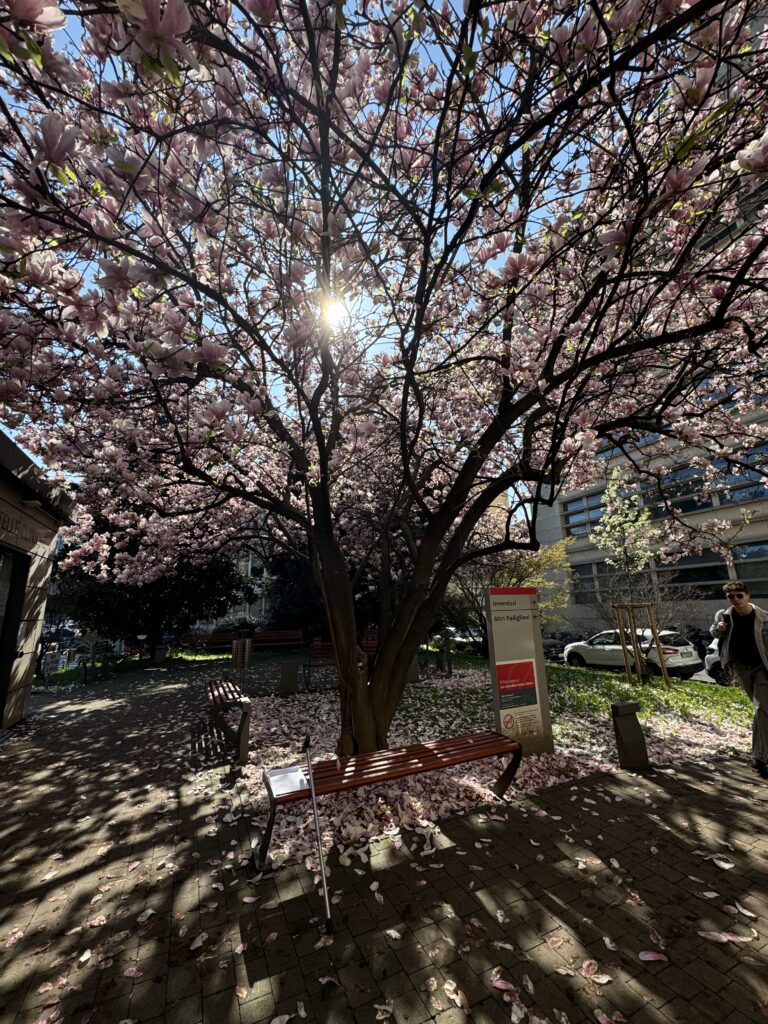
The surgeon doesn’t propose any solutions, because the risks outweigh the benefits. If it turns out to be an infected pseudoarthrosis, the infection could spread into the bloodstream and cause far more serious damage. Better to let a sleeping dog lie, for now. I walk out of the Rizzoli with emptiness in my eyes. I stop to cry in the Giardini Margherita.
I begin to understand that this will be a long tunnel — much longer than I had expected.
Meanwhile, my leg starts to hurt more and more. I go back to walking with crutches. In March I decide to seek other opinions. I can’t accept that this is the final situation — there must be a way to rebuild the tibia. I take a train to Milan. At the Galeazzi Hospital they share Bologna’s view. At the Policlinico, however, they propose a two-stage solution: the Masquelet technique, which I had already heard about.
The first phase involves replacing the “rotten” bone with a cylinder of antibiotic-loaded cement. The immune system attacks the foreign body, forming a vascularized biological membrane which, after eight weeks, will act as a container for the definitive bone graft taken from the hip.
They warn me, however, that it will be a long road (the first surgery won’t take place before the summer), and that my leg will never return to the way it was.
I’m demoralized, but at least now I have some prospect of improvement.
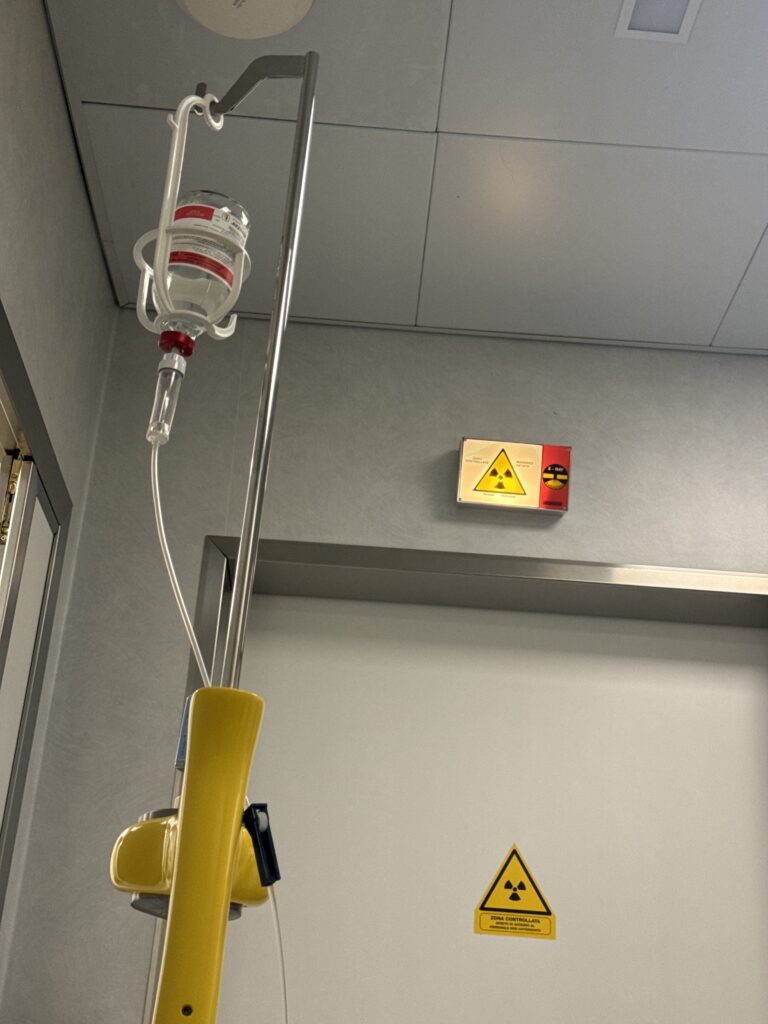
At the Sforza hospital they ask me to undergo a PET scan to determine whether there is an infection. The results arrive in early May: there don’t seem to be any signs of inflammation. I send the report to Bologna as well, hoping that, in light of the negative result, the team at the Rizzoli Institute might offer me the same surgery with shorter waiting times.
The next day the professor himself calls me.
“I’ve seen the PET scan. Your situation is a mess. The report is wrong. The infection is there — and it’s widespread. The only option is the Ilizarov.”
My world collapses. The Ilizarov is the technique I fear the most. It means living with an external fixator for more than twelve months.
The professor adds that in the public system the waiting times are too long and that the surgery would have to be done privately. The cost is €15,000. But I haven’t received a single euro since the day of the accident. Negotiations with Graband with the driver are frozen. I need to return to Bali for another police interrogation before proceeding with the civil case. And I have no desire to ask my parents for money for a surgery that I should be entitled to in the public healthcare system.
I spend entire days in bed. I don’t want to see anyone.
Then I react, but I keep ignoring the problem. I surround myself with friends, go out, go to parties.
Meanwhile the pain increases and a white bump begins to form. All the orthopaedic surgeons agree: it’s a purulent fistula.
But one night, shining the phone flash on the area, I see a serial code through the skin.
I’ve gone crazy, I think.
I search on Google and ask ChatGPT: that round white bump isn’t pus — it’s the head of a screw from the plate, about to break through the skin and come out.
I quickly pack a backpack and leave for Milan. Before going to the emergency room, I stop at a 24-hour Burger Kingnear the Sforza hospital. While eating a hamburger, I decide to change destination: I’ll go to the CTO Gaetano Pini instead. Online it looks like one of the best hospitals for complex trauma cases like mine.
The doctors understand that the situation is serious, but not urgent enough to hospitalize me immediately. The head of the department wants to see me. He says the tibia isn’t in disastrous condition. Maybe it will be enough to remove the “loosened” plate and replace it. During the same surgery he could also release my knee, sparing me another operation months later.
I’m thrilled: two birds with one stone.
The following week I’m already on the operating table. When I wake up from anesthesia they give me the bad news: the tibia wasn’t as healthy as it seemed. They had to perform the first stage of the Masquelet technique. Another surgery will be necessary in a few months.
Part of me had expected it. That’s okay. It’s only a partial disappointment, because on the knee front the operation was a success. In the operating room they achieved a range of motion of 120°. I can hardly believe it. The knee stiffness had always been my obsession. In the previous months I couldn’t sleep — both because of the pain and because of the thought that I might never recover simple activities like sitting down, walking downhill, or climbing stairs.
The post-operative period is tough, but I meet people with stories similar to mine. We give each other strength.
I start the summer feeling optimistic. I think I’m on the right track.
Soon, however, more disappointments arrive. Even with daily physiotherapy I can’t push my knee beyond 60–70° of flexion. The surgical wound doesn’t close: it keeps leaking fluid, becomes more and more irregular, until it eventually turns into a fistula.
In mid-July I go back to Milan for a check-up. They tell me that for the second stage of Masquelet we need to wait. First they want to clarify the condition of the tibia. They order more tests and schedule another appointment for the end of the summer.
The Roman phase
When I set foot back in Rome, I start to feel strange. At first it’s just an overwhelming fatigue that doesn’t go away with sleep or coffee. Then the chills come, followed by mental confusion. I take my temperature: 38.5°C. I don’t have time to go back to Milan. I rush to the emergency room at Umberto I Hospital, where my friend Giorgia joins me.
The blood tests leave no doubt: it’s the onset of sepsis. The infection is entering the bloodstream.
For the first time in a year, I’m afraid of dying.
They put an oxygen mask on me and start antibiotic therapy, along with paracetamol three times a day. On July 24, exactly one year after the accident, the surgeon tells me there’s no alternative.
The Ilizarov frame is the only way to avoid amputation.
August becomes one of the darkest moments of my life. Another summer is ruined, and I know I won’t be out of this until the end of 2026. My life is completely on hold.
On July 30 they perform a first debridement surgery, to take cultures and determine the most appropriate antibiotic therapy. Then they place a VAC — a device that continuously sucks the exudate from the wound in my leg, to be worn 24 hours a day.
The VAC is hell: it’s bulky and it keeps beeping, waking me up ten times a night. The only positive thing is that I’m allowed to go back home and spend three weeks with my family. It’s a strange summer, but still better than being in the hospital.
At the beginning of September the most feared day arrives. I have to undergo one of the most complex surgeries since the accident.
The orthopedic team will be joined by a plastic surgeon to cover the fistula with a pedicled muscle flap taken from my right calf — the medial gastrocnemius.
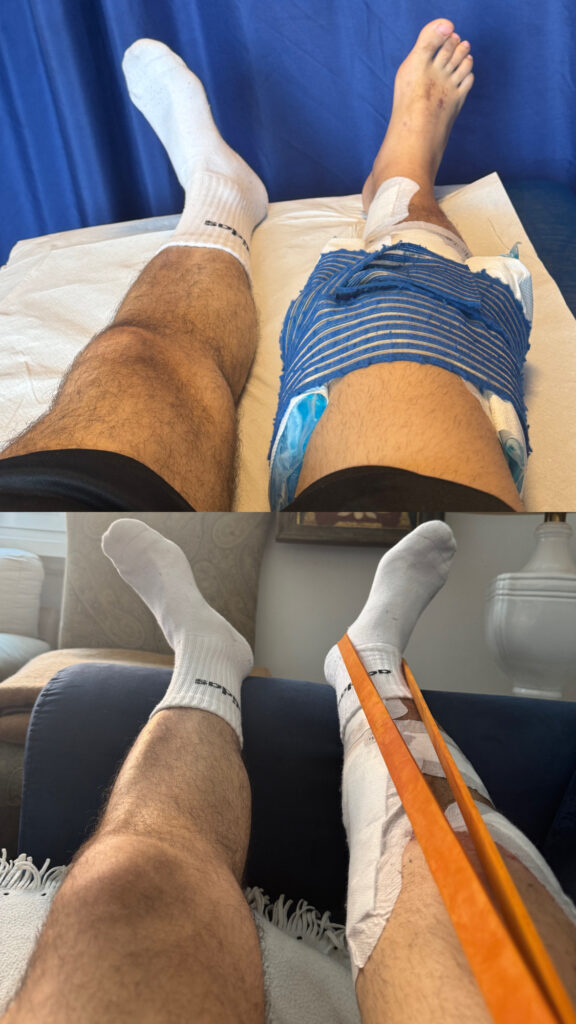
I enter the operating room expecting to come out with a circular Ilizarov external fixator. To my great surprise, when I wake up I discover that they have performed, for the second time, the first stage of the Masquelet technique. They did apply an external fixator, but a monolateral bar fixator, which I will only have to keep for a few months, until the second stage of the procedure.
Amid a whirlwind of emotions, I suddenly find myself optimistic again.
The intraoperative cultures reveal an infection caused by S. epidermidis and methicillin-sensitive S. aureus. After eight days in the hospital and intravenous therapy, I switch to oral antibiotics and I’m finally able to return to Sicily.
Once again, however, I’m required to show up in Rome every week. It’s not a small expense, considering that I haven’t worked for more than a year. But I don’t complain: I’m developing an inner strength I didn’t think I was capable of.
In October I leave for Milan to start a curricular internship at the newsroom of SkyTG24. It’s an experience of pure normality: I meet new colleagues, build a routine, and feel useful again.
I begin to accept my condition. I realize that it is not entirely incompatible with having a life.
It will be a different life — but still one worth living.
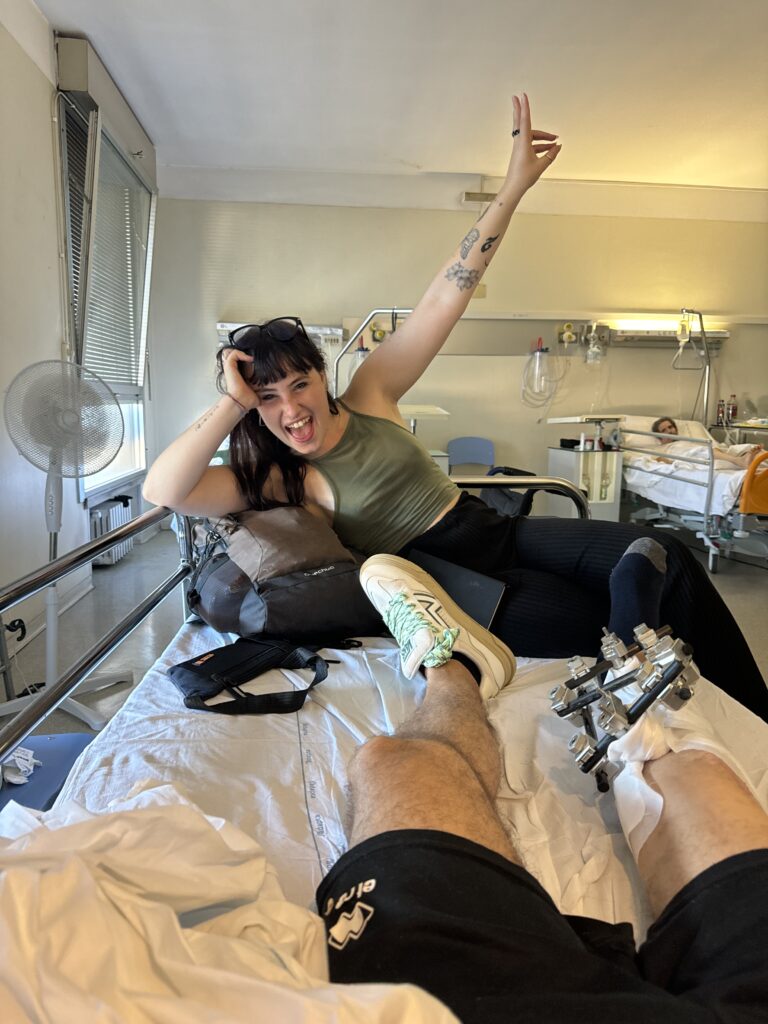
On Halloween, another blow arrives. During the weekly dressing change, the plastic surgeons realize that a new fistulahas opened: the antibiotic cement is exposed.
There’s no other option but to start over from scratch.
At the end of November I leave Milan, ready to undergo surgery again. After several delays, the third first stage of the Masquelet procedure is scheduled for early December. I fear they might have to redo the muscle flap as well, but they manage to extend the one already created from the medial gastrocnemius.
The operation falls just a few days before my graduation in journalism.
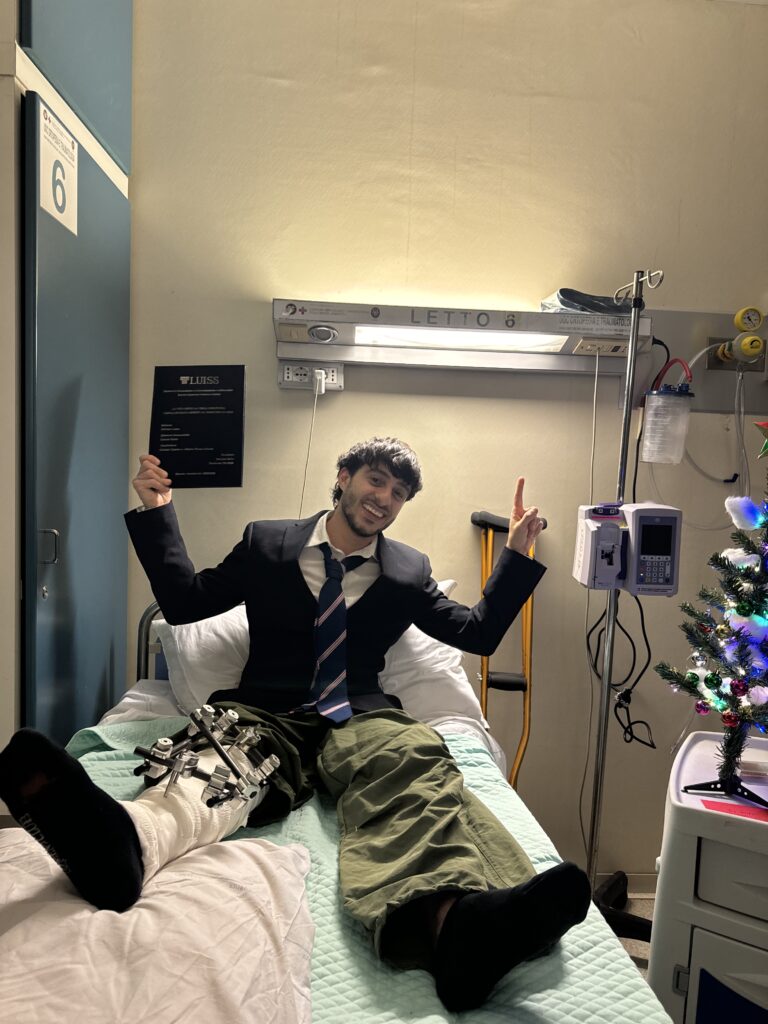
Until the very last moment I hope to defend my thesis in person, but they can’t discharge me in time. The remote ceremony feels a lot like the days of Covid: jacket and tie above, oversized Adidas pants below, to fit around the external fixator. I don’t have a laurel wreath, but my friend Martina places a virtual one on my head in a photo. That weekend there are supposed to be celebrations with all my classmates. On Friday afternoon my backpack is already packed, ready to leave, when the final twist arrives.
They’ve found a new bacterium, a multi-drug resistant staphylococcus.
I’ll have to stay in the hospital for at least another seven days to set up a new antibiotic therapy. I’m exhausted and break down in tears.
The following Tuesday they explain the situation to me. The standard therapy would require daily intravenous infusions for three months. I would have to remain hospitalized well beyond the Christmas period. But the infectious disease specialist manages to obtain approval from the hospital committee for an off-label treatment with dalbavancin — administered every two weeks or once a month.
Christmas is saved.
Once again I return to Sicily. And once again I know that every Wednesday evening there is an Intercity Notte waiting for me.
This time things start going wrong from the very beginning.
The stitches don’t close: something underneath is putting tension on the suture line. Just three weeks after the surgery they have to remove a 200-gram hematoma, stitching me up again while the tissue is still raw. For a few weeks the wound seems to hold, but I have the feeling that, once again, everything is falling apart. I’m depressed. I spend the month of January sleeping, eating, and watching Turkish TV series with my mother.
At the beginning of February my fears are confirmed. While doing the daily dressing with gauze and chlorhexidine, I touch something hard.
I’m horrified. It’s the cement, once again.
When I go back to Rome the doctors no longer know what to tell me, except that I’m extremely unlucky. We have to start everything from scratch: a fourth first stage of the Masquelet technique, new cement, a new flap. This time there are no muscles left in my right leg that can be used. They will have to take a free flap from my left thigh — an Antero-Lateral Thigh (ALT) flap.
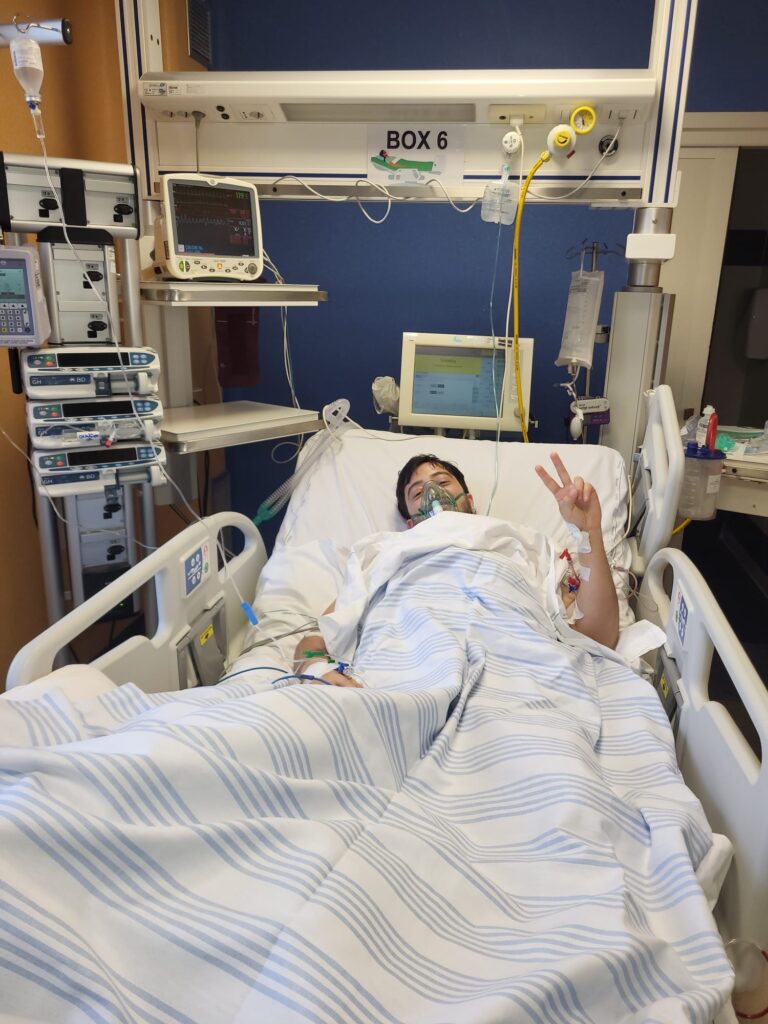
It will be a very long operation: twelve hours of microsurgery to connect the blood vessels of the flap to those at the recipient site. After the first 24 hours in intensive care, I will have to spend ten days in the ward under close monitoring.
“This time it has to work,” they tell me.
It’s the second-to-last cartridge to save the leg from amputation. The last one would be the Ilizarov, a prospect I don’t even want to think about right now.
Meanwhile, the extremely long timelines of orthopedic treatment do not go well with the pace of Indonesian justice.
If I want to obtain even a minimal compensation, I need to return to Bali to continue the investigation phase before the police close the case. Neither my lawyers nor the offices of the Italian embassy in Jakarta have been able to secure a remote interrogation.
An ending yet to be written
I apologize to anyone who has read this far hoping to find a reassuring ending. This is a story still unfolding: even though eighteen months have passed, the events keep bouncing us back to the first chapter.
Something, however, has changed since July 24, even if only in a subtle way. A mild form of acceptance has begun to make its way inside me.
I kick and struggle a little less.
I don’t know how many summers will pass before I can swim in the sea again, how many months before I can walk without crutches. How many years before a bike ride, a full workout at the gym, a day of trekking. I don’t even know whether any of this will truly be possible, or whether it’s just a mirage I cling to so I don’t collapse completely.
But I do know that what once felt like a suspended life is, in reality, simply a different life.
Over the past months and years I have been surrounded by beautiful people who have shown me what friendship really means. They have stayed close to me with a plate of pasta, a glass of wine, a walk in the park.
I often say that what I miss most is improvising. It’s difficult when your autonomy is so limited. Yet I’ve managed to sketch a few small detours. I’ve spent short periods away from home, met new companions along the road, shared stories.
With effort, I’m learning to decorate the tunnel, to make it a little more colorful.
I may not be able to climb Everest — that’s true — but I can read, write, produce techno music with Ableton, learn a language. Even if in a slower, less restless way, I am still continuing to live.
I’m saving my energy for the moment when life gives me the chance to take another leap.
And to you, who are reading this, I want to say thank you — for your time, and for giving me the chance to share everything I had been carrying inside, through writing.